When Stillness Becomes the Service: The Rising Premium American Men Place on Presence Without Pressure
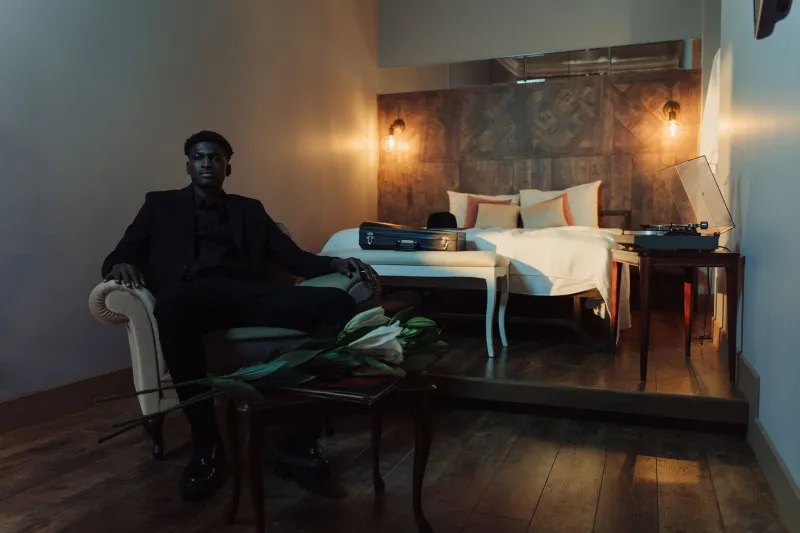
There is a particular exhaustion that does not appear on any medical chart. It has no clinical name, no pharmaceutical remedy, and no productivity app designed to address it. It is the fatigue that accumulates when every relationship in a man's life — professional, social, even romantic — carries an implicit expectation of performance. When every room demands that he be sharper, funnier, more decisive, or more impressive than the last time he entered it.
For a growing segment of accomplished American men, the antidote to this exhaustion is not a vacation, a meditation retreat, or a weekend of isolation. It is something far more counterintuitive: the company of another person who asks absolutely nothing of them.
The Performance Tax on Modern Affluence
Success in contemporary American professional culture is rarely a destination. It is, more accurately, a continuous audition. The executive who closes a major deal on a Thursday is expected to arrive Friday morning with equal or greater energy, vision, and authority. The entrepreneur who builds something remarkable is almost immediately asked what he plans to build next. Even leisure has been colonized by performance metrics — golf handicaps, fitness benchmarks, social media documentation of experiences that must appear curated and aspirational.
Psychologists who work with high-net-worth individuals have noted a pattern that rarely makes headlines: the wealthier and more accomplished the individual, the more pervasive the sense that he is always being evaluated. Relationships with colleagues, subordinates, and even friends carry subtle power dynamics that make genuine relaxation nearly impossible. A man in this position cannot afford, socially speaking, to be uncertain, tired, or simply quiet.
This is the invisible tax that affluence imposes. And it is one that money, paradoxically, cannot easily buy its way out of.
Silence as a Sophisticated Commodity
What Chandigarh's most refined companion culture has understood — and what is only now entering the American conversation — is that the absence of demand is itself a form of care. The companion who does not require a man to be "on," who does not interpret a lull in conversation as a social failure, who can share physical and emotional space without filling it with expectation, is offering something genuinely rare.
This is not passivity. It requires considerable emotional sophistication to be comfortable with another person's quietude without reading it as rejection, disinterest, or inadequacy. It requires the kind of social confidence that does not depend on constant verbal affirmation. And it requires a professional temperament that understands the difference between engagement and entertainment — recognizing that the former is about genuine presence, while the latter is a transaction dressed in warmth.
For American clients encountering this quality for the first time, the experience is frequently described in terms that sound almost therapeutic. Not because anything clinical has occurred, but because the simple act of being with someone who places no evaluative framework on the interaction produces a measurable sense of relief.
Why Judgment-Free Presence Is Not the Same as Indifference
It is worth distinguishing between two very different things: the companion who is inattentive or disengaged, and the companion who is fully present without imposing expectations. The former is a failure of professionalism. The latter is its highest expression.
The most sought-after companions in Chandigarh's premium market are not sought after because they are passive or undemanding in a hollow sense. They are sought after because they have mastered the art of attunement — the ability to read what a client actually needs in a given moment and respond to that need rather than to a script. Sometimes that need is lively conversation. Sometimes it is an evening of companionable quiet, a shared meal without the obligation of being interesting, or simply the physical comfort of another person's presence without the weight of social accounting.
This attunement is, in many respects, the opposite of indifference. It demands active attention and genuine empathy. But it channels that attention toward the client's actual state rather than toward the companion's own need to be perceived as entertaining or engaging.
The American Reckoning With Rest
There is a broader cultural shift underway in the United States that makes this conversation timely. The mythology of relentless productivity — the glorification of the 80-hour work week, the fetishization of hustle culture — is facing increasing scrutiny from the very demographic it most aggressively recruited. High-achieving men in their late thirties, forties, and fifties are beginning to articulate, often privately, that the life they built does not leave much room for the person who built it.
This reckoning is driving interest in experiences that prioritize restoration over stimulation. It is why wellness travel has exploded as a luxury category. It is why executive coaching now frequently addresses emotional regulation alongside strategic thinking. And it is, in part, why the model of companionship that centers comfort over performance is finding an increasingly receptive audience among American men who have everything the market can sell them — except relief from the pressure of being themselves in public.
Redefining What Premium Companionship Delivers
For those considering an engagement with Chandigarh Companions, understanding this dimension of the experience is useful context. The platform's emphasis on discretion, professionalism, and genuine personal compatibility is not incidental to the service — it is the service. The logistical elements of a companion engagement are, in a sense, the infrastructure that makes something more valuable possible: an encounter in which a man is neither performing nor being evaluated, but simply present.
This is not a small thing. In a world that has commodified nearly every form of human attention and interaction, the experience of being with someone who does not need you to justify your quietness, explain your mood, or maintain a particular version of yourself is, for many accomplished men, genuinely extraordinary.
The art of meaningful silence, it turns out, is not about the absence of conversation. It is about the presence of someone who understands that conversation is not always the point.
And in a market crowded with offerings that promise excitement, novelty, and stimulation, that understanding may be the rarest luxury of all.